How to hang something heavy without it falling off the wall
This guide recommends one product, with an Amazon affiliate link. If you buy through it, I may earn a commission at no extra cost to you. Read the affiliate disclosure.
The short answer
Heavy things fall because the screw is only holding drywall, not wood. A screw into a stud can hold a lot. A screw into drywall alone can hold almost nothing. Find the stud first, and if there is no stud where you need it, use the right anchor for the weight. About 20–30 minutes.
What you need
- A stud finder, a level, a pencil, and a drill with drill bits.
- A lag screw or heavy hook, if you are going into a stud.
- Toggle bolts or heavy-duty wall anchors, if there is no stud — match the anchor to the weight.
Step by step
Step 1 Find the stud
Hold the stud finder flat on the wall and slide it slowly side to side. Mark the left and right edges where it beeps or lights up. The middle of those two marks is the center of the stud. Check it twice. Studs are usually 16 inches apart, so if you find one, the next one is usually 16 inches to the side.
The stud finder I recommend: Franklin Sensors ProSensor 710 Stud Finder.
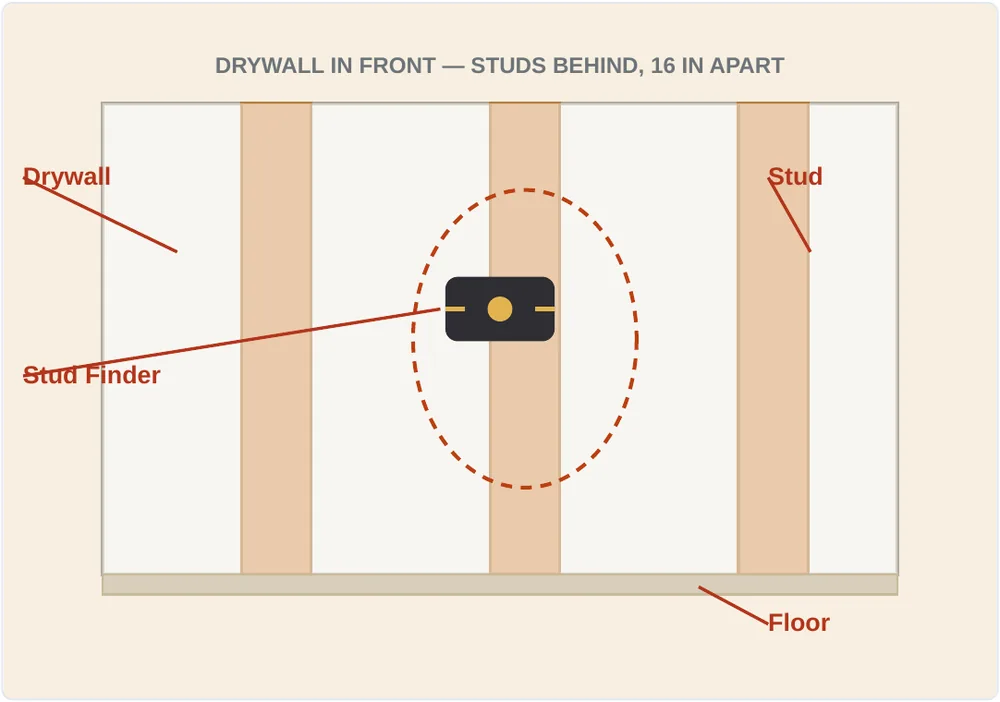
Studs are usually 16 inches apart. Step 2 No stud there? Pick the right anchor
If there is no stud where the item has to go, do not just use a bigger screw in drywall — it will pull out. Use a toggle bolt for heavy things — it opens up behind the drywall and spreads the weight. Use a heavy-duty wall anchor for medium weight. Check the weight limit on the pack and stay well under it. If the item is heavier than the anchor is rated for, move it to a stud or use two anchors.
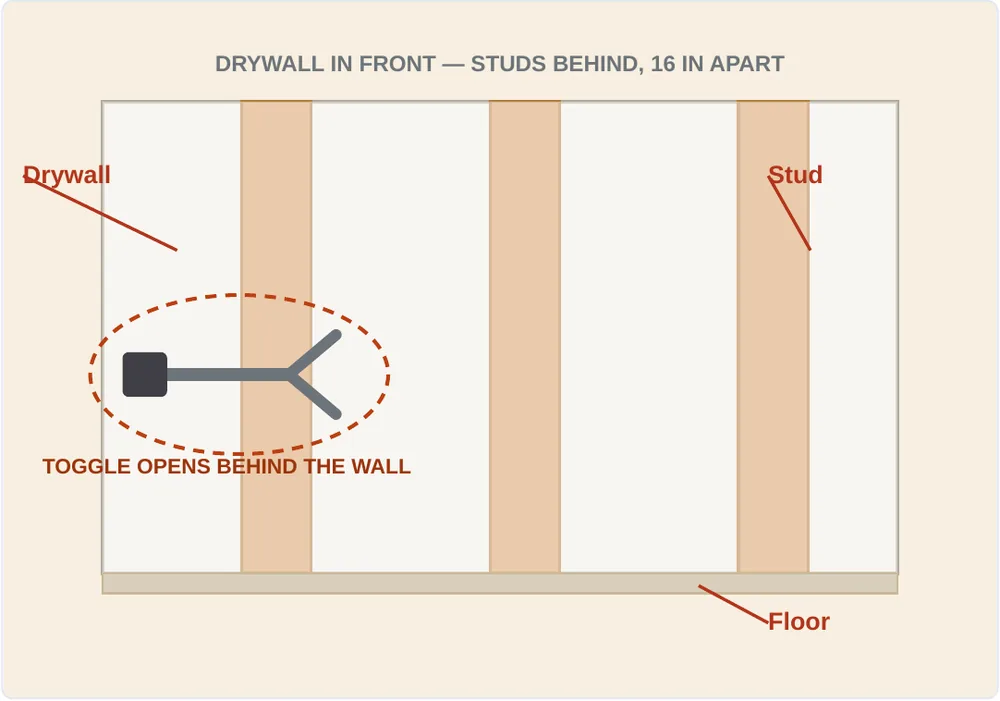
A toggle bolt opens behind the wall. Step 3 Check what's behind the wall, mark it level, then drill a pilot hole
Before you drill: pipes and wires run inside walls. They often run straight up and down from outlets and switches, and above and below sinks and toilets. Don't drill directly above or below an outlet or switch, or into the wall behind a sink or toilet. If the bit hits something hard that isn't wood, stop — it could be a pipe or a wire, or a metal plate put there to protect one. Don't force the bit.
Hold the item, bracket, or mount against the wall and mark the screw holes with a pencil. Put the level on top, adjust until it is level, then mark again. Drill a pilot hole at each mark — smaller than the screw. For a stud, drill into the center of the stud. For a toggle bolt, drill a hole big enough for the toggle to pass through when folded.
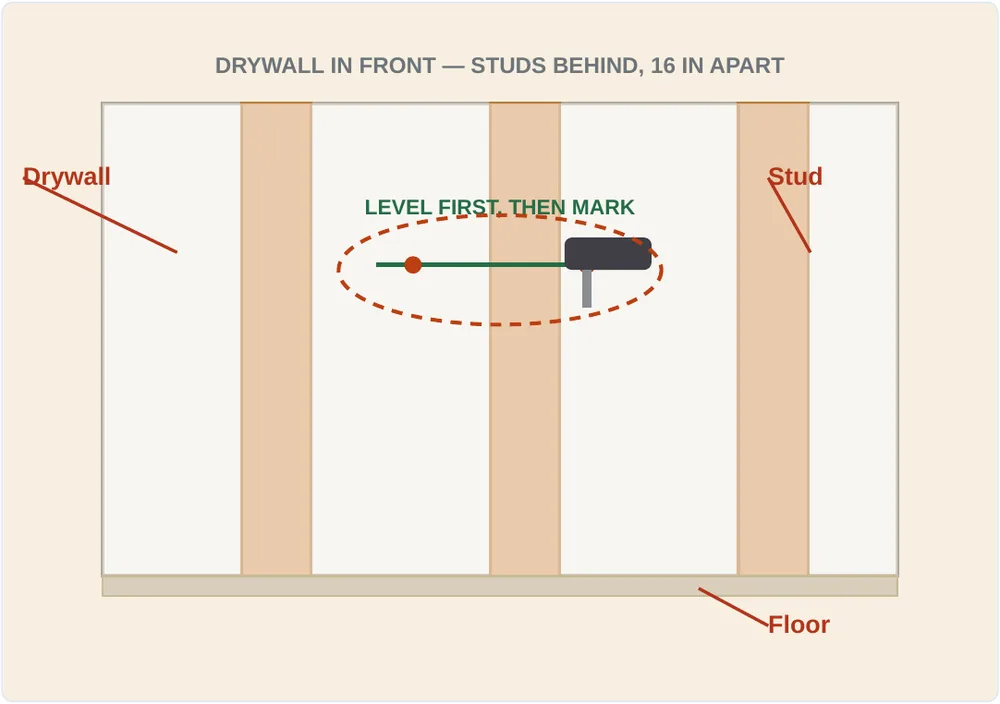
Level first, then mark. Step 4 Drive the screw or set the anchor
Into a stud: drive the lag screw or hook into the pilot hole until it is tight. Into drywall with a toggle bolt: push the folded toggle through the hole, let it open behind the wall, pull it back snug and tighten the bolt. With a wall anchor: push the anchor in, tighten it until it grips, then drive the screw into it. Do not overtighten — you will crush the drywall.
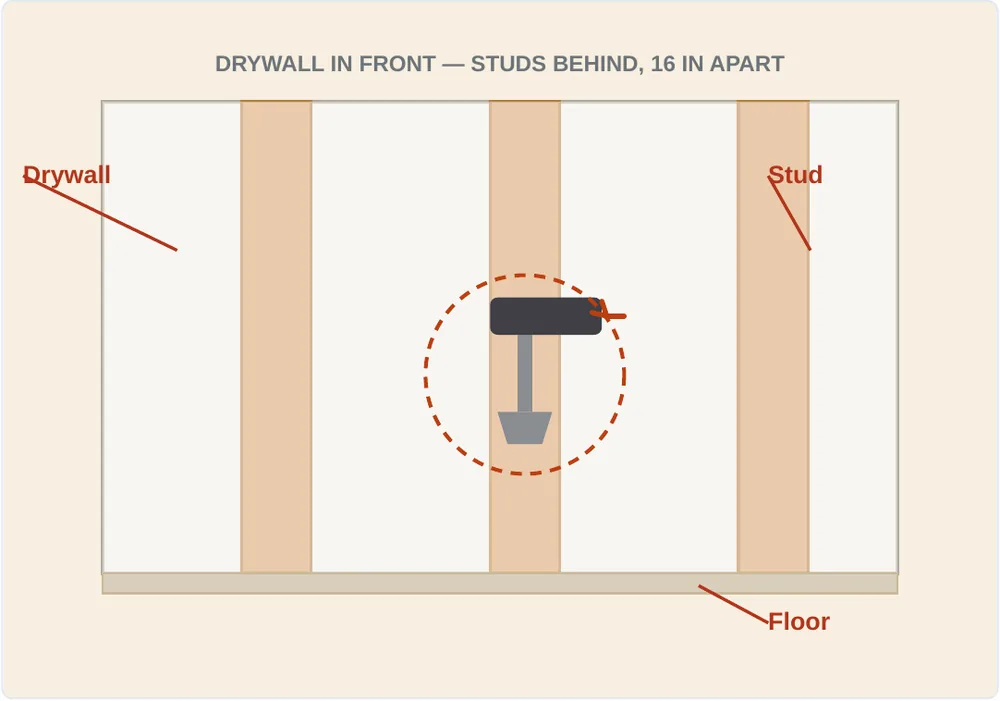
Step 5 Hang it and test it
Hang the item and check it with the level again. Then test it: pull down on it firmly with both hands, about the same weight as the item. If it moves, sags, or the screw turns, take it down and redo it — into a stud, or with a stronger anchor. Better to find out now than at 2 a.m.
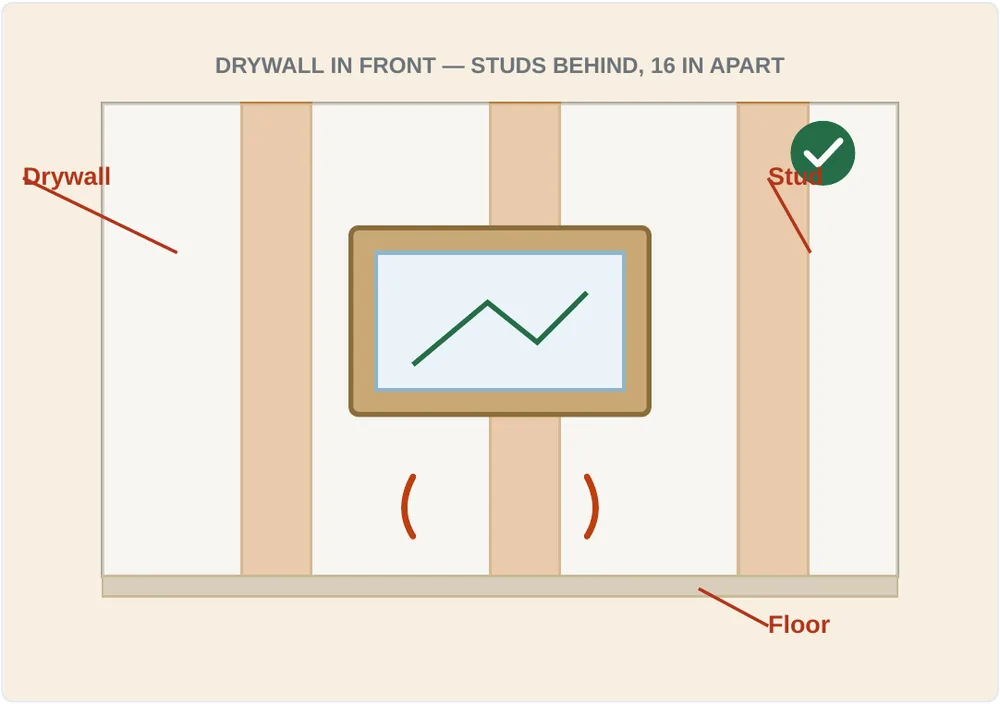
What not to do
- Don't hang anything heavy from a plain screw or nail in drywall alone.
- Don't guess where the stud is — knocking on the wall is not reliable.
- Don't drill directly above or below outlets and switches, or behind sinks and toilets — that's where pipes and wires usually run.
- Don't use an anchor rated for less than the item weighs.
- Don't overtighten a toggle bolt or anchor — it will crush the drywall and lose its grip.
- Don't hang a TV, a heavy shelf, or a cabinet from one screw. Use two screws or bolts, into two studs if you can.
When to call a pro
- The item is very heavy — a big TV, a wall cabinet, or anything over 50 pounds — and there is no stud where it has to go.
- The wall is plaster, tile, brick, or concrete, not drywall.
- You hit something hard while drilling that is not a stud — stop, do not force it. It could be a pipe or a wire.
- You drilled into something and see water, or the breaker trips.
Why this works
A stud is solid wood behind the drywall, and a screw into it grips all the way through. Drywall is just a thin sheet — a screw in it alone has nothing to hold on to. A toggle bolt works because it opens up behind the sheet and pulls against a wide area. That is why the same screw that holds a picture frame will pull straight out of the wall with a heavy shelf on it — it is not the screw, it is what the screw is holding on to.
Free printable California Earthquake Checklist
Get the one-page checklist — what to do this week, this month, and when the shaking starts and stops. Stick it on the fridge.
No spam. Unsubscribe anytime. See the privacy policy.
Disclosure and disclaimer — please read
Disclosure: This guide recommends one product, with an Amazon affiliate link. If you buy through it, I may earn a commission at no extra cost to you. Read the affiliate disclosure.
Disclaimer: This guide is general information only, not professional advice. I am not a licensed contractor. Every wall and home is different, so use your own judgment, check what is behind the wall before you drill, and stop if anything looks wrong. If you are not comfortable doing any step, or the item is very heavy, call a licensed pro. By following these steps you do so at your own risk — I am not responsible for damage, injury, or any other loss that may result.