Why is my garbage disposal not working?
This guide recommends one product, with an Amazon affiliate link. If you buy through it, I may earn a commission at no extra cost to you. Read the affiliate disclosure.
The short answer
Most of the time a garbage disposal stops because it is jammed, or because it tripped its reset button. Both are a 10-minute fix, no plumber needed, and no new disposal needed.
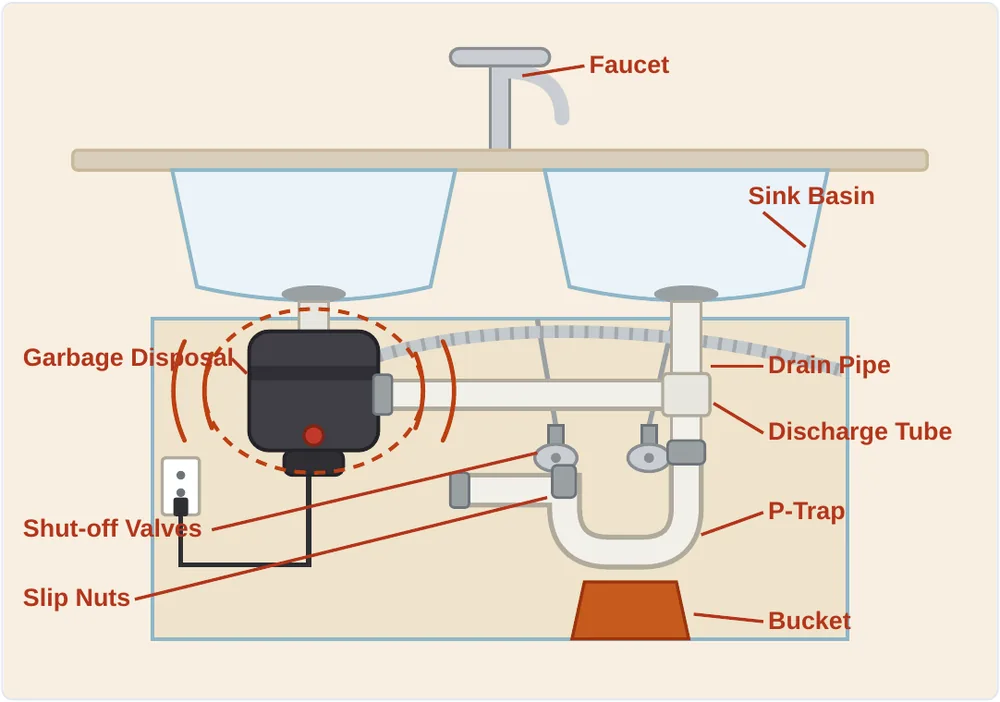
First, listen to what it does when you turn it on: if it hums, it has power and is jammed. If it does nothing at all, it has no power, or the reset has tripped.
What you need
- The Allen wrench that fits the socket underneath the disposal — usually 1/4 inch, and it often comes with the disposal.
- A flashlight.
- Tongs or pliers, to pull out whatever is jamming it.
- Old towels, just in case.
- Cold water running when you test it.
Step by step
Step 1 Listen once, then turn it off
Keep your hands and any tools out of the sink. Flip the disposal switch on for one second and listen, then switch it OFF and leave it off while you work:
- It hums — it has power and the motor is trying to turn, but something is stopping it. That is a jam. Go to Step 3.
- It does nothing, no sound at all — it has no power, or the reset has tripped. Go to Step 2.
Never reach into a disposal that could turn on.
Step 2 If it does nothing: reset it, then check power
Look underneath the disposal for the small red reset button on the bottom. Press it in firmly until it clicks. Then turn the disposal on again. If it still does nothing:
- If it has a plug, check that it's plugged in under the sink — the plug can work loose.
- Check the breaker for the kitchen, and the GFCI outlet if the disposal is on one — reset the GFCI if it has tripped.
- If it still does nothing after the reset, the breaker, and the plug are all checked, the motor may be dead — see when to call a plumber.
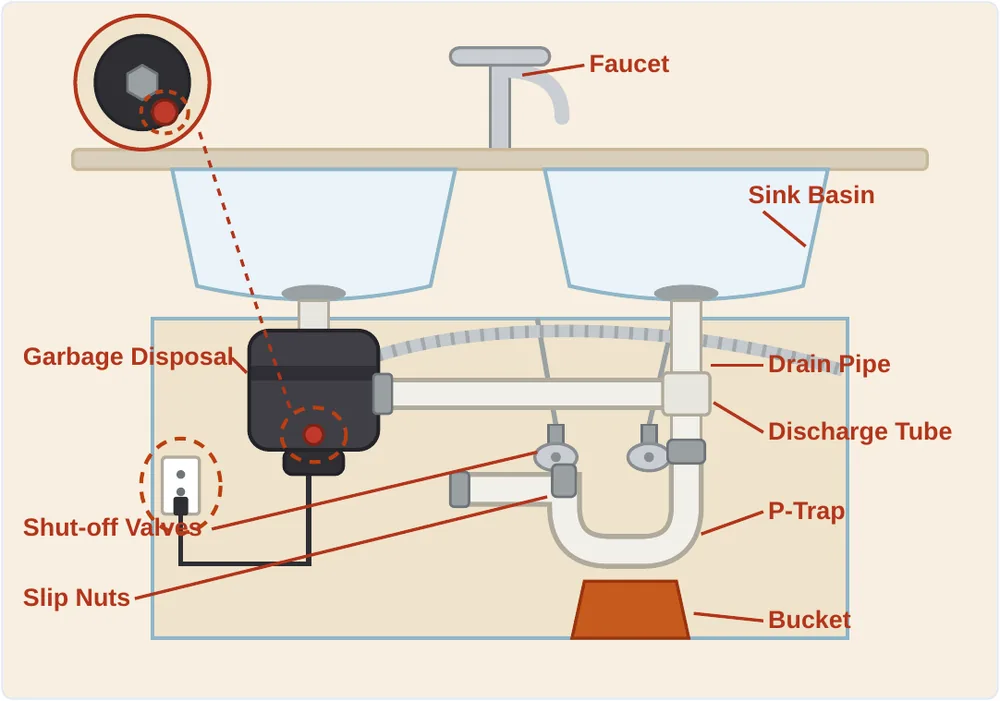
The red reset button is on the bottom of the disposal. Step 3 If it hums: cut the power, then free the jam with the Allen wrench
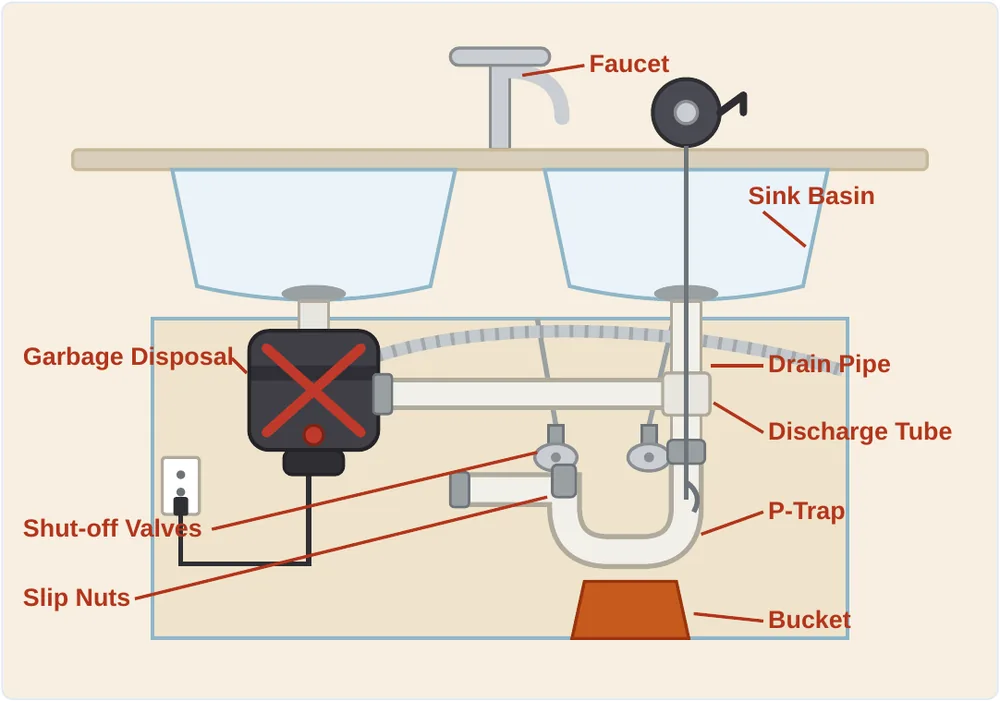
Before you put the wrench in, make sure the disposal cannot turn on: turn the switch OFF, and unplug it under the sink. If it's hardwired (no plug), turn off the disposal's breaker at the panel, then flip the wall switch to check that nothing happens, and switch it back off. Do not work on it while it still has power.
With the power off, put the Allen wrench in the hex socket in the center of the bottom of the disposal. Work it back and forth — a quarter turn one way, then a quarter turn the other — until it turns freely all the way around. That is the flywheel breaking free from whatever was jamming it.
Do not force it hard. If it will not move at all, go to Step 4 and look for what is stuck in there first.
Lost the disposal wrench? The hex key set I recommend: Klein Tools 70550 Folding Hex Key Set (11 SAE sizes, includes 1/4 inch).
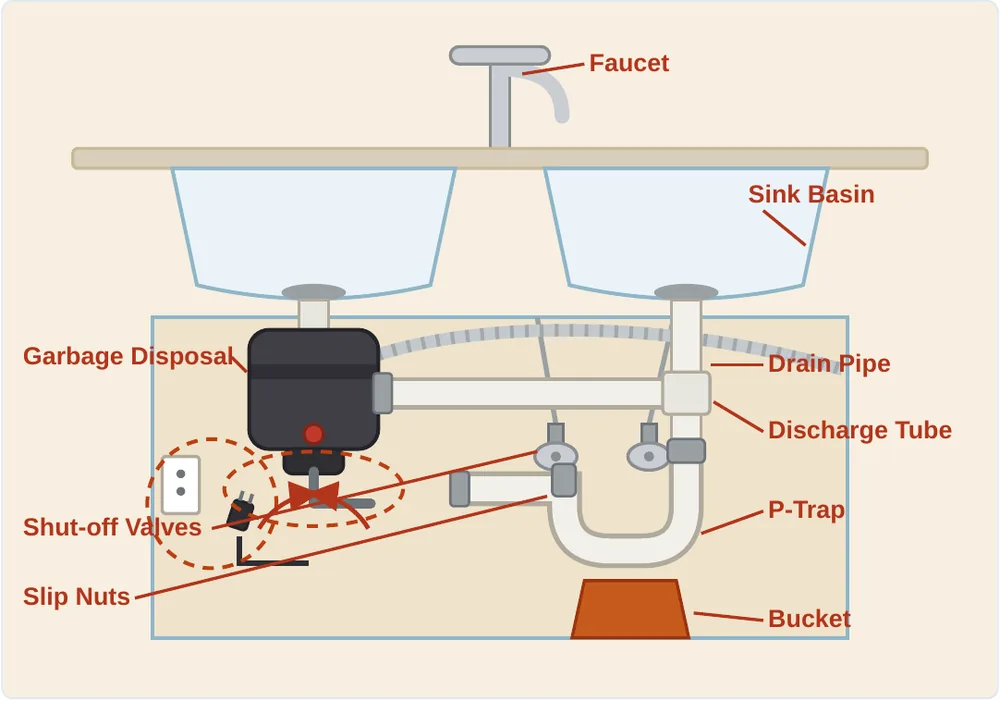
Unplugged (or breaker off), wrench in the socket underneath. Step 4 Look inside and pull the jam out
With the power still off, shine the flashlight down into the disposal from the top. Look for what is stuck — a bone, a bottle cap, a piece of silverware, a fruit pit. Pull it out with tongs or pliers. Never put your hand inside the disposal, even with the power off.
Once it is out, work the Allen wrench back and forth again from underneath — it should turn freely now.
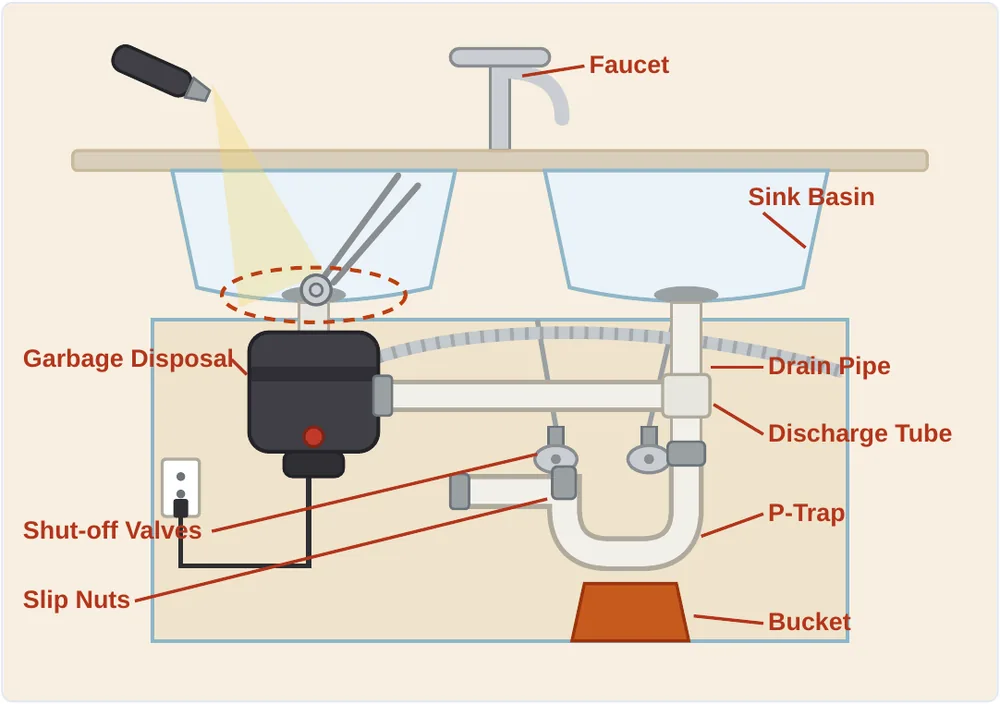
Flashlight and tongs — never your hand. Step 5 Test it
Plug the disposal back in, or turn its breaker back on, and press the red reset button underneath once more, in case it tripped while it was jammed.
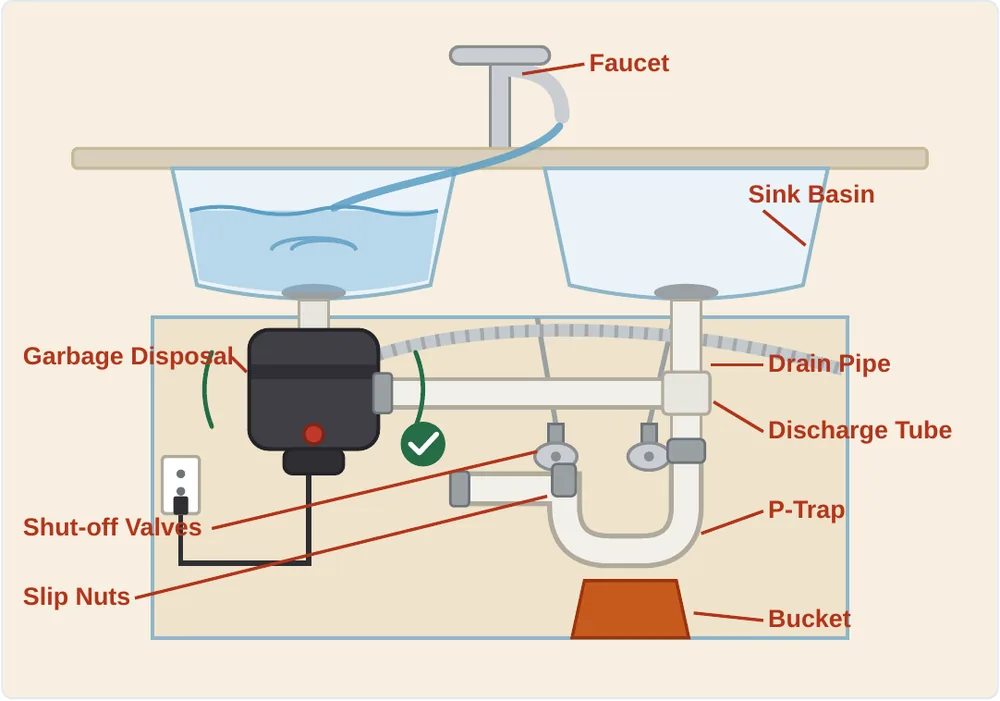
Turn on the cold water, then turn the disposal on. Let it run for 20–30 seconds with the water still running. It should sound normal — no humming, no grinding, no rattling. Turn it off, then turn the water off. If it runs normally, you are done.
What not to do
- Never put your hand inside the disposal — not even with the power off. Use tongs or pliers.
- Don't keep holding the switch on while it hums — that overheats the motor and trips the reset again.
- Don't pour chemical drain cleaner into a disposal — it does not clear a jam, and it splashes back.
- Don't run the disposal without cold water running — it needs the water to flush food down.
- Don't put grease, coffee grounds, pasta, rice, or potato peels down it — that is what clogs and jams it next time.
- Don't plunge through the disposal. On a double sink, plug the disposal side and plunge the other side — see How to unclog a kitchen sink.
When to call a plumber — or replace it
- It hums and trips the reset again right away, even after you freed it and pulled the jam out.
- The Allen wrench will not move it at all, even after you pulled out everything you can see.
- It leaks from the bottom of the disposal — that usually means the seal inside is gone, and it is time for a new one.
- It smells like burning, or the motor sounds weak and slow.
- It is over 10–12 years old and keeps jamming — a new disposal is usually cheaper than another repair call.
Why this works
A disposal is a spinning plate with two small impellers, not blades. When something hard gets between the plate and the wall, the plate cannot turn, the motor hums, and the reset trips to protect it. Turning the plate by hand with the Allen wrench breaks the jam free, the reset gives it power again, and cold water flushes the food down. That is why most "dead" disposals are not dead at all — they are just jammed and tripped.
Free printable California Earthquake Checklist
Get the one-page checklist — what to do this week, this month, and when the shaking starts and stops. Stick it on the fridge.
No spam. Unsubscribe anytime. See the privacy policy.
Disclosure and disclaimer — please read
Disclosure: This guide recommends one product, with an Amazon affiliate link. If you buy through it, I may earn a commission at no extra cost to you. Read the affiliate disclosure.
Disclaimer: This guide is general information only, not professional plumbing advice. I am not a licensed plumber. Every disposal and home is different, so use your own judgment, turn off the disposal (and its breaker, if it is hardwired) first if you are unsure, and stop if anything looks wrong. Never put your hand inside a garbage disposal. If you are not comfortable doing any step, call a licensed plumber. By following these steps you do so at your own risk — I am not responsible for water damage, injury, or any other loss that may result.